
A lot of commercial shops can tell you their bid win rate before the coffee is poured. Twelve electrical packages went out last quarter and four came back signed, so someone writes a percentage on the whiteboard and the review moves on. I have sat in those rooms. I have also been the person who wrote the percentage, and I can tell you that the number felt like we understood the quarter when we mostly just had a habit of writing it down.
The trouble was not that we counted wins. The trouble was that the count stood alone. When someone asked why the occupied suite had signed for less than we bid, or why the warehouse file had sat so long that the award went elsewhere, the room went quiet. We could say how often we won, and we could not say what we had bid against what we signed, what fee we had carried, or how many days the cycle had taken.
A bid win rate is the share of decided commercial bids that closed as an award. The simple way to write it is wins ÷ decided bids. Pending work stays out of the count until the owner or the GC decides. The rest of this page is the log we learned to keep under that number, told the way a shop actually learns it: slowly, after a few quarters of guessing.
What the number is actually counting
If you mix the files that are still sitting with the GC into the denominator, you count a pending bid as a loss. That makes the month look finished when four bids are still open. Three awards, five declines, and four packages still waiting is three wins out of eight decided bids, not three out of twelve. We learned this the hard way when a slow medical-office file came back as an award in the next quarter and our old log had already counted it as a loss.
There is a second way people talk about the same quarter, and it does not need another equation. The count tells you how often you won. The dollars tell you which size of package you are actually building. A shop that wins the short IDF closets and loses the 5,800 square foot suites will feel busy on the whiteboard, and the backlog will be short of the larger work.
We also started naming every bid as a real commercial package, not a nickname that only one estimator understood. A vacant office tenant-improvement power and lighting job, an occupied-suite night package, a retail fixture rollout, and a school IDF add are four different invites. If two people cannot find the same row six weeks later and mean the same thing by it, the win rate is still just a number you can say out loud.

Write the row while you still remember the bid
Once we trusted the count, the next problem was the empty row. The log has to be written while you still remember who else sat on the list and which addendum moved the footage. A row filled in six weeks later is a guess with a date on it, and I have written enough of those to stop pretending they help.
On every bid we write the same few things, in the same order, so the later review does not depend on whoever happens to remember the job. We name the package — the commercial assembly, the drawings, and the addenda we actually sent. We write the outcome with only three honest values: won, lost, or pending. We pick one reason from a short closed list and we leave a note that is still true later, something as plain as the GC kept the house electrical shop. We write the bid price and the signed total. We write the fee we carried, and the signed fee if it moved. We write who else was invited and one fact we heard. We write the days from the branded send to the decision.
The reason list is short on purpose, because a growing list of extra reason codes wrecks the tally by Friday. Price means the owner or the GC said the bid price was high. Scope means the drawings or the inclusions did not match the invite. Package means the other offer included work we excluded, or excluded work we included. Late means the file missed the window. Incumbent means the buyer already had a shop. Cancelled means the project stopped. We pick one primary code and we lock it. Changing the code after the review to protect a person erases the only clear signal the log has.
Bid is the owner-facing total we sent. Award is the total on the accepted page. When those two differ, both belong on the row. One of our wins was a 2,400 square foot occupied suite offered at $24,980. The owner asked for a lower price, and we signed at $23,400. That is a $1,580 concession sitting on the bid, not a new estimate and not a change to the library rates.

Margin, on this page, is the fee we planned: the fee percent on the proposal stack, and overhead if we vary it. The direct library rates stay where they are. A loss tagged Price on an eight percent fee and a loss tagged Price on a twelve percent fee are two different lessons. The twelve percent row may be a bid we priced at a fee the buyer would not pay, rather than a raceway rate that ran long.
We also write the other shops on the invite and one fact that is still true later — a number we heard, a package that included fire alarm, a GC who always brings the same electrical house. Cycle time is the days from the branded send to the decision. A six-day win and a twenty-two-day loss are different bids even when they used the same raceway rate, and a log that cannot tell them apart will teach you the wrong lesson about the library.
Why named unit rates make the later review possible
Even a complete row is hard to use if the bid behind it is a lump. A commercial unit rate is a small cost model on one unit, under named conditions: labor hours, loaded wage, material, waste, and the tools that ride with the unit. Overhead and fee sit once on the proposal. That breakdown is written out in how unit rate estimating works. The library is useful because two estimators can price the same partition the same way, so a win or a loss is still comparable six weeks later.
When the bid is a stack of named extensions, the log can show the stack. You can see that the 4,200 square foot vacant suite used 1,850 linear feet of three-quarter-inch EMT, sixty-four devices, and forty-eight specified two-by-four lay-ins, and that Addendum 1 added footage before we sent. A lump labeled second-floor electrical cannot tell you which assembly the owner bought. After award, added footage is a change order from the awarded rates, which is job cost rather than a second bid outcome.
We version the rate when stick or wages move. Sent proposals keep the version they used, and the log stores that version next to the outcome so a later review does not compare today’s raceway number to last spring’s send.
One quarter in an electrical shop
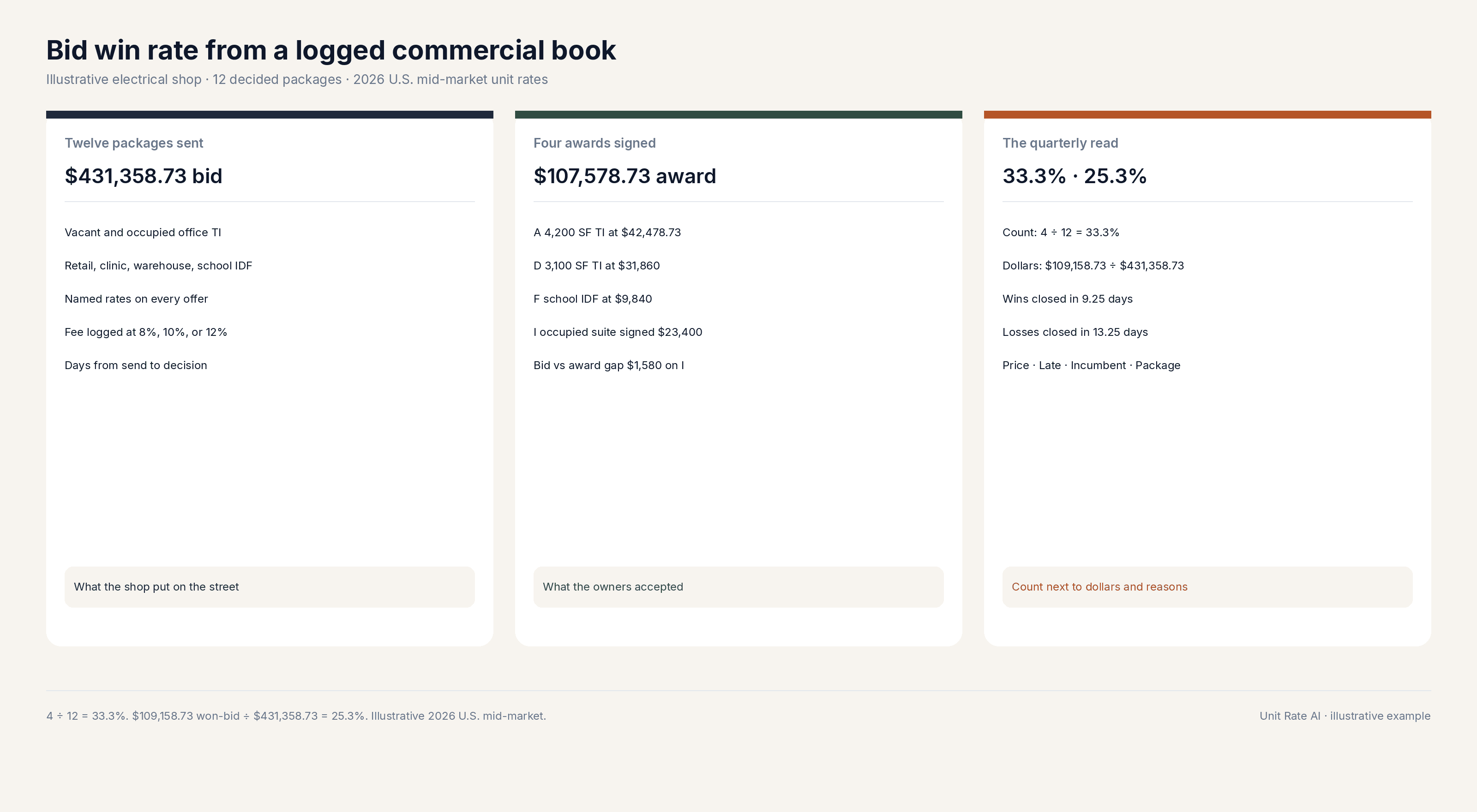
The first quarter we kept this way looked ordinary on the whiteboard and much clearer in the log. The shop in this story is an illustrative commercial electrical contractor bidding tenant-improvement and interiors-adjacent packages in the 2026 U.S. mid-market, and every dollar is an illustrative unit rate. Twelve invites closed and four awarded. The first win, Bid A, is the vacant 4,200 square foot second-floor suite that runs through these guides, offered at $42,478.73. That suite package is the same electrical stack described in tenant improvement estimating.
The wins looked alike once we lined them up. Bid A went out with named rates and came back signed at the bid price, eight percent fee, twelve days. Bid D was a 3,100 square foot vacant office tenant improvement for a repeat GC at $31,860, nine days, the same eight percent. Bid F was a school IDF closet at $9,840; an addendum extended the window and it signed in six days. Bid I was the occupied suite I already mentioned, the one that signed $1,580 under the bid price.
The losses lined up too. Bid G, a 5,800 square foot office tenant improvement at $68,220, carried a twelve percent fee and came back tagged Price. Two other Price losses, a retail lighting rollout and a 4,800 square foot office, sat at the same eight percent the wins carried, which is a different conversation than Bid G. The warehouse high-bay sat twenty-two days and arrived Late. The medical office stayed with the shop the buyer already had. One clinic file lost on Scope, a restaurant file lost on Package, and a small data closet was lost when the project was Cancelled.
Four awards out of twelve decided packages is the win rate for that shop. The count says we won one time in three. The dollars say the wins sat on the smaller packages: the IDF closet, the repeat-GC suite, the vacant 4,200 square foot tenant improvement, and the occupied suite that signed under the bid price. We did not need a second formula to see that. We needed the log.
What changed on the next twelve
The point of the log is the next invite list. Improvement, for us, was a change to that list, to the next fee, or to the next library version, written against a reason we could tally. A rising win count on small IDF closets while the larger suites stay on the loss list is a mix problem, and chasing a higher count by sending only the closets will leave the backlog short of the larger work.
Bid G became the fee conversation. That suite took a Price tag at twelve percent while every win sat at eight, so either the next file for that GC carries eight percent, or we stop spending hours on twelve percent fee bids that buyer will not pay. The two Price losses at eight percent sent us back to the library, to version those assemblies or walk away. The warehouse that sat twenty-two days told us to reuse the rates we already had, so the next file could leave the same week. We started spending fewer hours on buyers who already had a house shop. The scope loss sent us back to the takeoff-to-proposal handoff, and the package loss sent us back to the exclusion list against what that GC actually buys. The cancelled data closet made us look harder at invite quality. The occupied suite signed $1,580 under the bid price, and we had to decide whether the next occupied rate should already carry the concession we gave.
The easy misses make next quarter unreadable, and they are almost always the same ones. Counting pending as lost turns an open bid into a bad month. One cell that says lost on price hides the fee and the code. Logging the lump means Bid A is only a total on the page, and nobody can see the raceway, the devices, or the fixtures. Mixing change orders into the win folds job cost into a bid outcome. Growing a new reason code every Friday wrecks the tally. Comparing three bids this month to forty last year is too few bids to call a trend.
A cleaner log does not make you win more work by itself. It makes the next choice clearer. You can see whether you are losing on fee, on the library, on the clock, or on invites you should not have taken, which is what we actually wanted once we stopped treating the whiteboard percentage as the answer.
Unit Rate AI keeps a private unit-rate library and turns it into client-ready proposals, so the win and the loss can sit on the same record the client answered. If you want the library, the branded send, and that outcome log in one place, see pricing.