
A commercial proposal is accepted as sentences: scope, inclusions, exclusions, quantities, and a total. When those sentences drift from the unit rates that priced the job, the fight arrives after award. A PM hears “electrical” and buys fire alarm. A superintendent hangs after hours. The estimator says the $10.36 EMT rate already told that story. The proposal page has to say it in the language the owner can accept.
This article is the mapping: how rate-level includes and excludes become owner-facing scope. Rate anatomy lives in how unit rate estimating works. Library includes and excludes live in how to build a commercial unit rate library. The three documents live in takeoff vs estimate vs proposal. Bid-day sequence lives in how to price a commercial construction project. Recovery lives in overhead, fee, and contingency on commercial bids. After award, price the change order from the same rates. The commercial book versus a house quote is in commercial vs residential construction estimating.
Three places the language lives
Each layer answers a different reader. Mixing the readers is how a library note about firestopping never reaches the page the GC signs.
| Layer | Reader | Job | Source |
|---|---|---|---|
| Rate includes / excludes | Estimator, next estimator, reviewing principal | What one unit buys under named install conditions | The library item — hours, material, waste, tools |
| Proposal scope and inclusions | Owner, GC, or construction manager | The work you will install for this total | Rolled-up rate includes, plus drawings, specs, addenda |
| Proposal exclusions | Owner, GC, or construction manager | Work you can name and will leave out of this total | Rolled-up rate excludes, plus job-level items you did not price |
The rate is the internal engine. The proposal is the offer. Takeoff, estimate, and proposal stay three documents on the same book. Scope language is the hinge on the third. If the hinge is loose, a quantity change still extends and the owner still argues about what the line meant.
What belongs in scope
Scope is the job you are offering: drawings, specifications, addenda, the named assemblies, and the install conditions on the rates — vacant suite, standard shift, raceway ≤10' above finish floor. Write the set, the floor, the shift, and the assemblies so a PM can match the page to the walls six weeks later.
An electrical sub bidding a tenant-improvement suite is offering a defined Division 26 package. A GC coordinating interiors-plus-electrical-plus-HVAC is offering that stack. Commercial estimating keeps the package named. Keep drawings and addenda in the sentence. When an IDF closet lands before you send, the takeoff grows and the scope picks up the addendum. After award, the accepted scope is the baseline for a change order.
What belongs in inclusions
Inclusions are the work inside the offer, rolled up from rate includes to the assembly the owner recognizes. The $10.36 EMT rate includes stick, couplings, connectors, straps, hang, cuttings cleanup, and small tools. The owner-facing inclusion is “exposed 3/4\" EMT, hangers on typical spacing, 8'-0\" to 10'-0\" AFF, including couplings, connectors, and supports.” Wage and burden stay in the library. How overhead and markup work in Unit Rate AI is the product-side split.
Write one inclusion per priced assembly. Raceway stays on LF. Devices stay on EA. Fixtures stay on EA. When footage moves, the reader can see which inclusion moved. “Power and lighting complete” hides the hinge: 1,850 LF of raceway can grow while the device count stays put. Leave the rate condition on the sentence — exposed, ≤10' AFF, standard shift. After-hours in an occupied box is a different line.
What belongs in exclusions
Exclusions are work you can name and will leave out of this total. They come from rate excludes plus job-level items you never priced. Once this proposal prices devices and fixtures, drop those two from the exclusion list. Conductors, firestopping, above-ceiling, after-hours, lifts, dumpsters, and permits stay unless you add named rates.
Add packages the rates never saw — fire alarm, temporary power, permits paid by others, abatement, HVAC controls. Write the name. Silence is how a PM treats “electrical” as the whole floor.
An exclusion leaves the work out of the total. A contingency is money you may spend on a named risk. If above-ceiling MEP is excluded, skip a tagged contingency for the same hole. The overhead, fee, and contingency stack keeps that split. Convert a named unknown to scope when it becomes measurable.
How a unit rate becomes a proposal sentence
The handoff is mechanical when the library is honest. Pull the named rate. Set the quantity. Let the extension calculate. Write the inclusion from the rate’s includes and the exclusion from what that rate left out.
- Keep the unit identical. LF of raceway on the takeoff, the rate, and the proposal line.
- Promote includes to the assembly the owner recognizes. Stick and straps become “exposed 3/4\" EMT with supports.”
- Promote excludes that still apply. Conductors, firestopping, and after-hours move from the rate card to the exclusion paragraph when this proposal does not price them.
- Drop excludes you just priced. Once devices sit on an EA line, stop excluding devices.
- Apply overhead and fee once. How overhead and markup work keeps recovery off the unit unless you load it on purpose.
Unit rates stay internal unless the bid form asks for a unit-price schedule. The owner-facing page shows quantity, unit, line total, and the sentences that define the line. That is the loop unit rate estimating software is built to hold.
Worked example: electrical package on a 4,200 SF suite
The through-line is an illustrative 4,200 SF office tenant improvement — vacant second-floor suite, Class B building, standard shift. This worked example prices the electrical package a specialty sub would send: raceway, devices, and lay-in fixtures. Every dollar is an illustrative 2026 U.S. mid-market unit rate. The EMT build-up lives in how unit rate estimating works. The full interiors-plus-HVAC stack lives in the pricing workflow.
The three named rates
Pull the library. Set the quantities. Extend.
| Line | Qty | Unit | Direct rate | Extension |
|---|---|---|---|---|
| 3/4\" EMT, exposed ≤10' AFF | 1,850 | LF | $10.36 | 1,850 × $10.36 = $19,166 |
| Duplex / data devices | 64 | EA | $88 | 64 × $88 = $5,632 |
| 2x4 LED lay-in | 48 | EA | $215 | 48 × $215 = $10,320 |
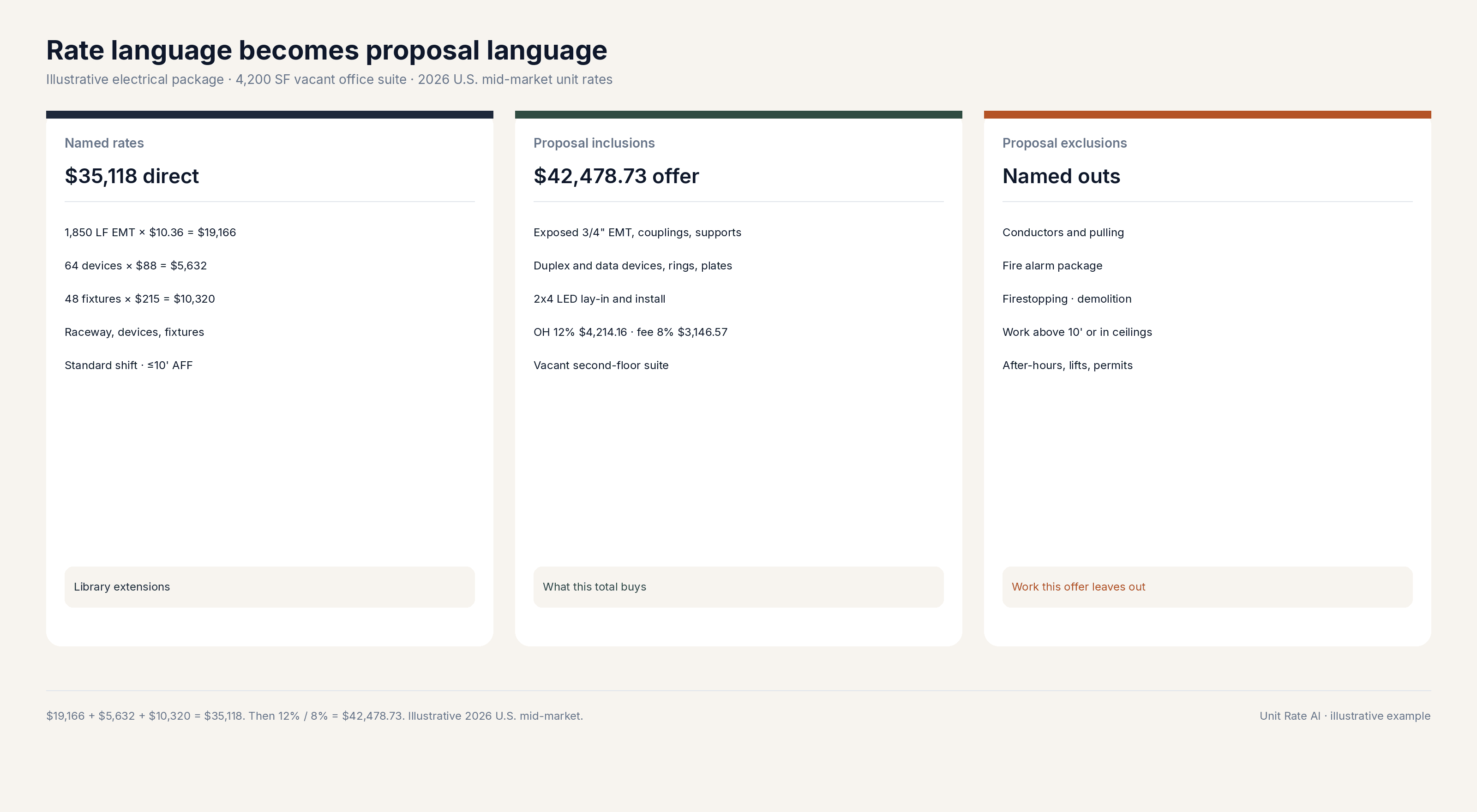
| Electrical direct | $35,118 |
Check the arithmetic: $19,166 + $5,632 + $10,320 = $35,118 direct. Library rates stay direct. Markup sits on the proposal.
- Overhead: 12% of $35,118 = $4,214.16
- Direct + overhead = $39,332.16
- Fee: 8% of $39,332.16 = $3,146.57
- Electrical offer: $42,478.73
That is $35,118 + $4,214.16 + $3,146.57. Above-ceiling work sits in exclusions, so there is no tagged contingency for the same hole. Electrical shops can map these units in electrical estimating software.
Rate includes become inclusion sentences
Write the owner-facing inclusions from the three rates. Keep the condition on the sentence.
| Library rate | What the unit buys | Proposal inclusion |
|---|---|---|
| EL | EMT | 3/4\" | exposed, ≤10' AFF | LF at $10.36 | Stick, couplings, connectors, straps, hang, cuttings cleanup, small tools | Exposed 3/4\" EMT, typical hangers, 8'-0\" to 10'-0\" AFF, couplings, connectors, supports — 1,850 LF |
| EL | device | duplex/data | EA at $88 | Device, ring, and plate; install on a prepared box | Duplex and data devices, rings, and plates as shown — 64 EA |
| EL | fixture | 2x4 LED lay-in | EA at $215 | Fixture and install into the specified grid | 2x4 LED lay-in fixtures and install — 48 EA |
Scope sentence for this worked example: “Furnish and install the power and lighting package for the vacant second-floor suite as shown on the architectural and electrical sets, standard shift, raceway exposed and ≤10' AFF.” The table names the assemblies.
Rate excludes become the exclusion list
Devices and fixtures dropped off the exclusion list because this proposal priced them. The rest stays on the page.
- Conductors and pulling (26 05 19). The $10.36 is raceway only.
- Work above 10' AFF or in ceilings. Plenum and lift work are other rates.
- Firestopping through rated walls.
- Fire alarm — devices, cabling, panel, programming. This page is power and lighting.
- Demolition of existing raceway or devices.
- After-hours premium, occupied-suite work, weekend shifts.
- Lifts, dumpsters, and permits.
- MC, rigid, or IMC — different raceway rates.
- Lighting controls beyond the specified 2x4 lay-in, emergency inverters, generator work.
How the sentences prevent the fight
Three requests show up on suites like this.
Before award — addendum adds an IDF closet and 290 LF of 3/4\" homerun, still exposed and ≤10' AFF. Takeoff: 1,850 + 290 = 2,140 LF. Estimate: 2,140 × $10.36 = $22,170.40 against $19,166.00 — a $3,004.40 move on raceway. New electrical direct: $35,118 + $3,004.40 = $38,122.40. Overhead: 12% = $4,574.69. Direct + overhead = $42,697.09. Fee: 8% = $3,415.77. Revised offer: $46,112.86 — $3,634.13 above $42,478.73. The inclusion picks up Addendum 1 and 2,140 LF. The exclusion list stays.
After award — the same 290 LF lands on the accepted $42,478.73. The takeoff measures the delta. The estimate extends the awarded $10.36. The change-order total is $3,004.40 direct + $360.53 overhead + $269.19 fee = $3,634.12. That sequence is in how to price a construction change order.
After award — the owner wants fire alarm, or after-hours hanging in an occupied suite. Those words sit on the exclusion list. They are new scope. Price fire alarm as its own package. Price after-hours as a condition on the same 1,850 LF — a different library rate, or the vacant-suite rate plus a stated premium. The sentences already told the buyer what $42,478.73 bought.
Writing the page the owner can accept
Put the layers in a stable order: scope paragraph, inclusion lines with quantity and unit, exclusion list, then recovery and terms. On this suite that is the vacant second-floor package, the three electrical assemblies, the named outs, and 12% / 8% applied once. Payment terms belong on the same page. Leave approval in a branded link the PM can find when the pay app is due.
The home product loop is built for that page: a private unit-rate library, proposal language next to the extensions, and a record of what the client did. More guides sit on the resources index. See pricing if you want the library and the owner-facing sentences in one place.
Common mistakes to avoid
- One sentence that says “electrical complete.” Name raceway, devices, and fixtures. Keep fire alarm excluded until you price it.
- Rate excludes that never reach the proposal. Conductors, firestopping, and after-hours have to appear on the owner-facing list.
- Excluding a line you just priced. Once 64 devices sit on the inclusion table, take devices off the exclusion list.
- Wire, boxes, and conduit in one LF inclusion. Keep raceway on LF; keep devices on EA.
- Leaving install conditions off the inclusion. Exposed ≤10' AFF and standard shift are part of the unit.
- A contingency for work you already excluded. If above-ceiling is out, skip a 3% tag on the same hole.
- Copying last suite’s exclusions onto this set. A hospital plenum and a vacant Class B suite do not share one paragraph.
- Sending the estimate as the proposal. $35,118 is a direct subtotal. The owner accepts $42,478.73 plus the sentences.
Software will not walk the suite for you. It can keep the named rates, the inclusion sentences, and the exclusion list on one book.
Unit Rate AI maintains a private unit-rate library and turns it into client-ready proposals. Keep labor, material, and markup in one place, write scope next to the extensions, and send a branded link. See pricing if you want that loop on the next suite.