
A unit rate is a price per measurable unit of commercial work — dollars per linear foot of conduit, per square foot of gypsum, per each door hardware set — that already contains the labor, material, and install assumptions you would otherwise rebuild on every bid.
Commercial GCs, specialty subs, and in-house estimators use that structure so two people price the same tenant-improvement scope the same way, and so a quantity change updates the total instead of forcing a new lump-sum guess. The rate is the internal engine. The proposal is what the owner or GC sees.
This article is the anatomy of the rate, and why commercial teams prefer it to a single number. It is not a library-hygiene manual. Naming, includes and excludes, versioning, and the overhead-versus-proposal rule live in how to build a commercial unit rate library. For the bid-day sequence around the rate — scope, takeoff, markup, terms — see how to price a commercial construction project.
What a unit rate actually contains
A strong commercial unit rate is not a single cell. It is a small cost model attached to one unit of measure, under named install conditions.
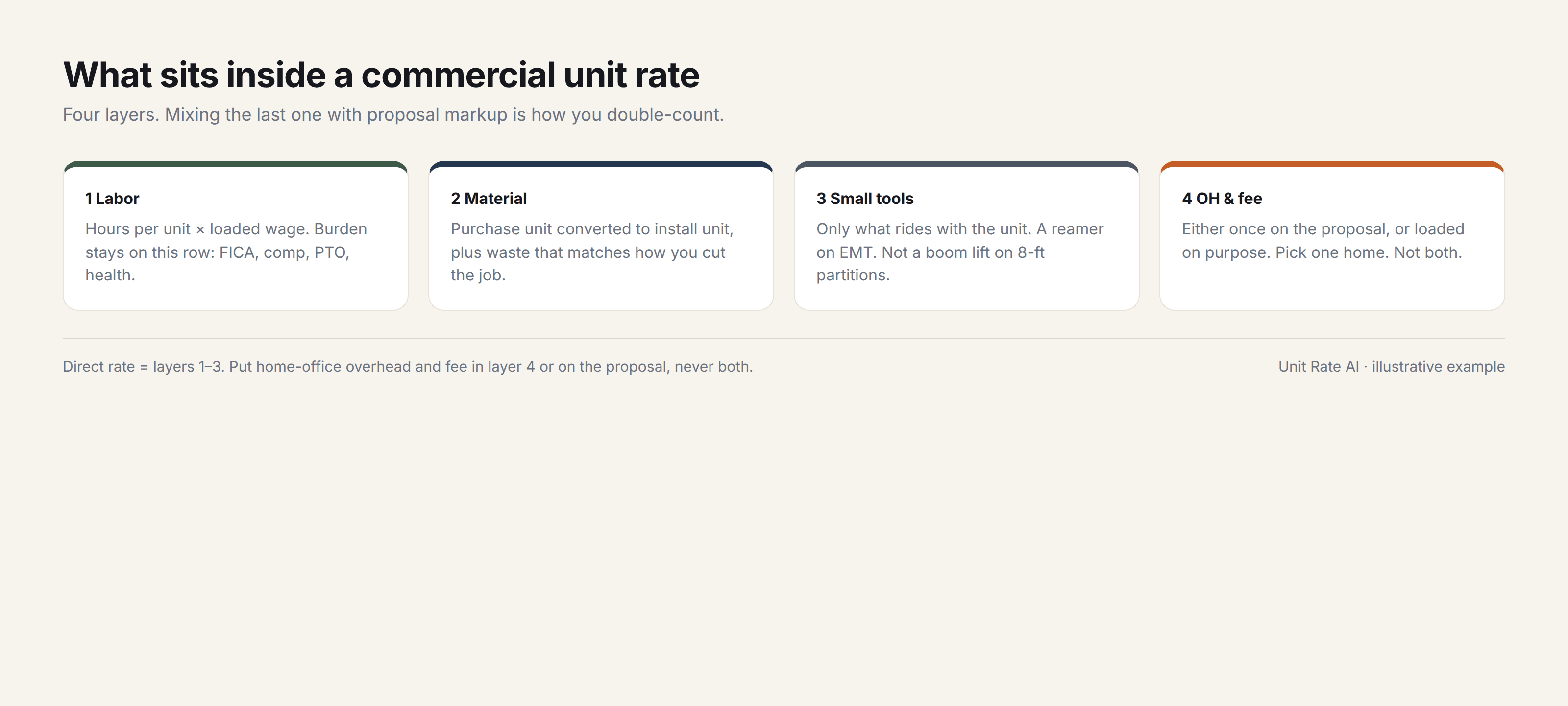
Four layers sit in that model:
- Labor — crew productivity (hours per unit), base wage, and labor burden (FICA, unemployment, workers' comp, payroll-related insurance, PTO, health).
- Materials — purchase units converted to the install unit, plus waste that matches how you cut and stock the job.
- Equipment or small tools when they ride with the unit (a reamer and blades on conduit; not a boom lift on 8-foot partitions).
- Overhead and fee — either applied once on the proposal, or loaded into the rate on purpose. Mixing those two methods is how you double-count.
When estimators skip the breakdown, the proposal still looks finished. The failure shows up later: an addendum changes footage, an alternate appears, or a PM asks why two similar TIs priced differently. The unit rate exists so those assumptions are visible, reusable, and tied to a quantity.
Two labels get used loosely in shops. Unit cost (or a direct unit rate) is what it costs you to install one unit with labor burden and waste in, and home-office overhead out. Unit price is often the client-facing number after overhead and fee. Either vocabulary is fine. Overwriting the direct library rate with the loaded number is not. How overhead and markup work in Unit Rate AI is the product-side version of that split. The bid-day stack — including why contingency stays off the unit — is in overhead, fee, and contingency on commercial bids.
A unit rate is also not a building-level shortcut. "$85 per square foot of suite" can be a sanity check after you extend the lines. It is not a rate. It hides partitions, raceway, doors, and the HVAC quote in one average, which is the lump-sum problem wearing a unit costume.
The worked example below is an illustrative 2026 U.S. commercial mid-market tenant improvement. The dollars are not RSMeans. They are not a real client's rates. Replace every input with your wage sheet, your supplier quote, and your crew's production on this condition.
Worked example: 3/4" EMT, commercial TI
Job: install 3/4" electrical metallic tubing, MasterFormat 26 05 33, on a typical office tenant improvement.
Rate name: EL | EMT | 3/4" | exposed, ≤10' AFF, commercial TI | LF
Unit: linear foot of installed raceway.
Conditions: exposed 3/4" EMT, hangers on typical commercial spacing, 8'-0" to 10'-0" above finish floor, vacant suite, standard shift, material stocked to the floor. Cut-up TI with offsets around ducts and corners — not warehouse-length industrial runs, not above-ceiling work, not a hospital plenum.
Includes: EMT stick, couplings, set-screw connectors, straps and supports, cut/ream/couple/secure, and daily cleanup of cuttings in the work area, plus small tools.
Excludes: conductors and pulling (26 05 19), boxes and device rings (priced each), MC cable, rigid or IMC, work above 10' AFF or in ceilings, firestopping, demolition, devices, fixtures, after-hours premium, lifts, dumpsters, and permits.
Labor hours, wage, and burden
TI conduit is slower than a long exposed run in an empty shell.
- Production: 10 LF per labor-hour (0.10 hr/LF)
- Base wage: $52.00/hr (plausible 2026 mid-market U.S. commercial electrician composite)
- Labor burden: 40% (FICA, unemployment, workers' comp, payroll-related insurance, PTO, health)
- Loaded wage: $72.80/hr
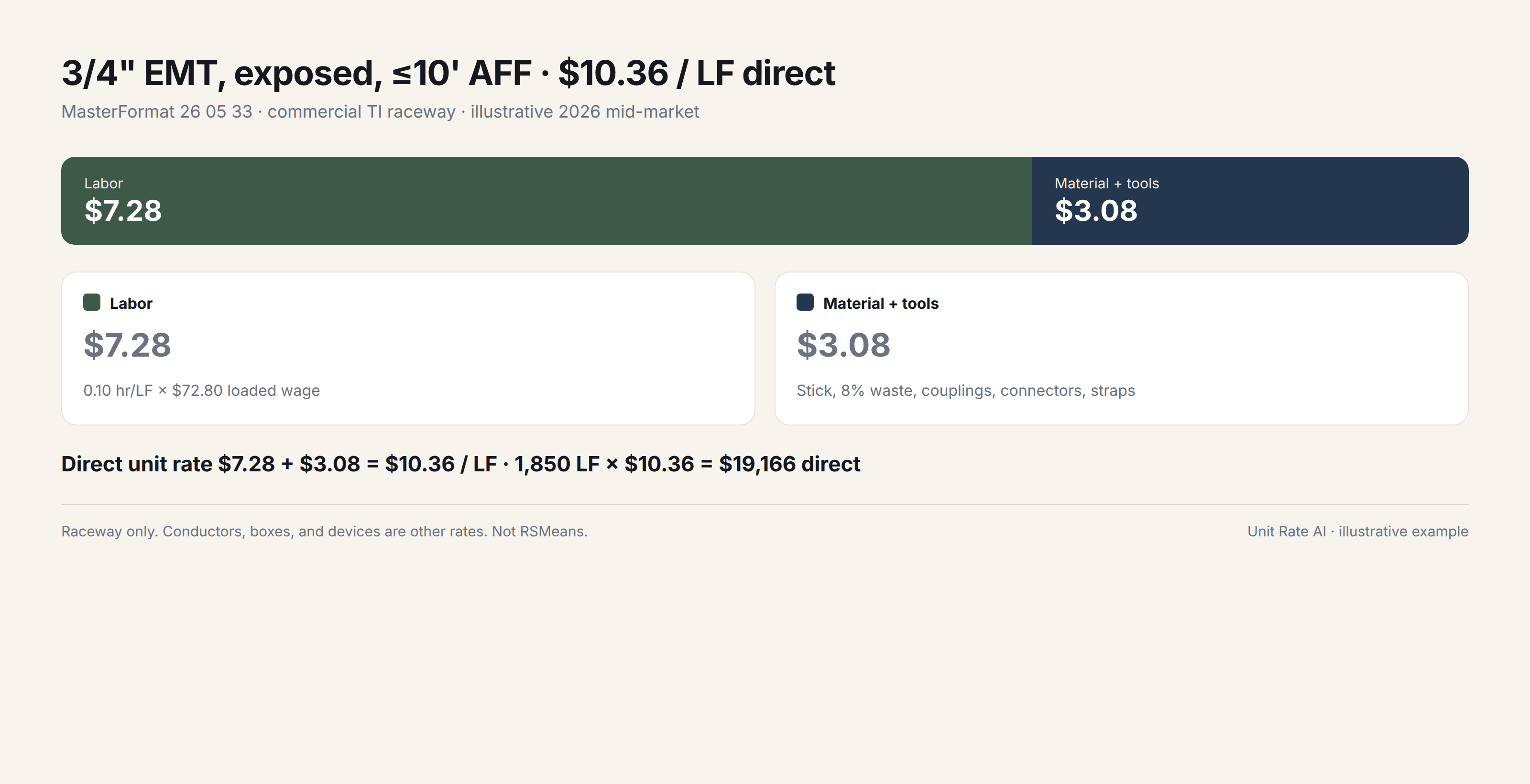
- Labor in the rate: 0.10 × $72.80 = $7.28/LF
Those inputs move. Union coastal metros often sit well above this wage; some Sunbelt non-union shops sit below it. After-hours work in an occupied retail box is not this productivity. A 1-1/2" homerun, or EMT above a finished ceiling, is a different rate — not a silent 15% in a proposal cell.
Burden belongs on the labor row. If workers' comp or a health contribution lands, version that input. Do not hide it inside "OH."
Material, waste, and small tools
Illustrative 2026 delivered pricing, mid-U.S. metro:
| Input | Assumption | Cost in the rate |
|---|---|---|
| 3/4" EMT, 10-ft stick | $24.00/stick delivered ($2.40/LF) | — |
| Stick waste | 8% (offsets and cut-up TI) | $2.59/LF |
| Couplings | 0.10 EA/LF @ $1.20, 8% waste | $0.13/LF |
| Set-screw connectors | 0.08 EA/LF @ $1.80, 8% waste | $0.16/LF |
| Straps / supports | 0.15 EA/LF @ $0.85, 8% waste | $0.14/LF |
| Small tools / consumables | blades, reamer, bits | $0.06/LF |
| Material + tools | $3.08/LF |
Waste applies to material, not to labor hours, and not twice. If takeoff is net installed LF, waste lives on the material rows. If someone also inflates the footage in takeoff, you double-buy stick.
Direct unit rate (no overhead, no fee): $7.28 + $3.08 = $10.36/LF
On 1,850 LF of 3/4" EMT (a plausible raceway takeoff on a small office TI): 1,850 × $10.36 = $19,166 direct. Markup is a separate decision. Store $10.36/LF as a direct rate. Apply overhead and fee at proposal level unless the bid form forces a single loaded unit price.
For a trade-specific view of this workflow, see electrical estimating software for commercial shops.
The gypsum equivalent of this build-up — hang and finish 5/8" Type X at an illustrative $2.54/SF — is worked in the commercial unit rate library guide. Do not copy that table into every bid. Point at the library rate and extend the quantity. The published 3/4" EMT, exposed unit is on the 3/4" EMT, exposed library — those dollars are a different packet from the $10.36 mid-market table above.
Unit rate estimating vs lump sum
Lump-sum bidding can work on a small, familiar package with one crew and no addenda. On commercial work with dozens of line items, a lump sum hides the error until bid day — or until the change order.
A lump sum answers "what will you do this job for?" A unit rate answers "what is one measurable piece, under these conditions, and how many pieces are on this set of drawings?" The first is a promise. The second is a model you can revise.
The difference is not academic when the electrician's footage changes. Suppose the 1,850 LF of 3/4" EMT above was rolled into a lump-sum electrical number — "$48,000 for rough-in and trim" — because that is what went to the last similar suite. An addendum then adds a new IDF closet and 290 LF of 3/4" homerun. Under the unit rate, the raceway line extends: 2,140 × $10.36 = $22,170 direct, a $3,004 move on EMT alone. Wire may also grow; devices may not. You can see which part of Division 26 moved. Under the lump sum, the PM either eats the homerun, invents a round-number change order the owner cannot check, or rebuilds the entire electrical guess from memory. That is the commercial case for unit rates: quantity takeoff drives the total, and a scope revision does not require a new theory of the job.
Lump sum still has a job. A single custom millwork desk, a mechanical sub quote you do not break down, or a bid form that only accepts one number on the signature page can stay lump. The pricing workflow covers when to keep a lump line on an otherwise unit-rated proposal. The mistake is using lump sum as the default because the library was never built.
Unit-price contracts and unit-rate estimating are cousins, not twins. A public unit-price bid form asks you to publish loaded unit prices the owner will use on overruns. Your internal library can still store direct rates and load them for that form. Do not overwrite the master with the published number; the next negotiated TI will not use the same markup.
Building a rate library that survives turnover
Most contractors start with historical bids and vendor quotes. That is a pile of files, not a library. The library is the shared cost file that keeps the next estimator from pricing 3/4" exposed EMT with last year's 1/2" ceiling number.
Keep this page short on hygiene. The operating system — names that encode scope and conditions, includes and excludes on the rate, labor burden and waste that match the install, version history when steel or wages move, and a rule for whether overhead lives in the rate or on the proposal — is the job of the commercial unit rate library article.
What belongs here is the reason that file has to outlive one estimator:
- If the only 3/4" EMT number lives in a sent PDF, turnover resets the company to lump sum.
- If two people keep private spreadsheets, you do not have a rate. You have an argument on bid day.
- If you silently overwrite the master when EMT stick jumps, last quarter's proposals and open change orders no longer match the library.
Build the library around the packages you actually send: tenant improvement, retail rollout, multifamily common areas. An 80-item book that is current beats a CSI encyclopedia nobody trusts. Takeoff still happens in STACK, Bluebeam, or whatever you already use to measure drawings. The library prices the quantities. It does not count them.
From unit rates to client-ready proposals
Unit rates are internal. Clients should see scope, quantities, units, and line totals — in a PDF or an online review link — not your wage and burden rows, unless the bid form demands a unit-price schedule. Takeoff, estimate, and proposal are three documents on that path — see takeoff vs estimate vs proposal.
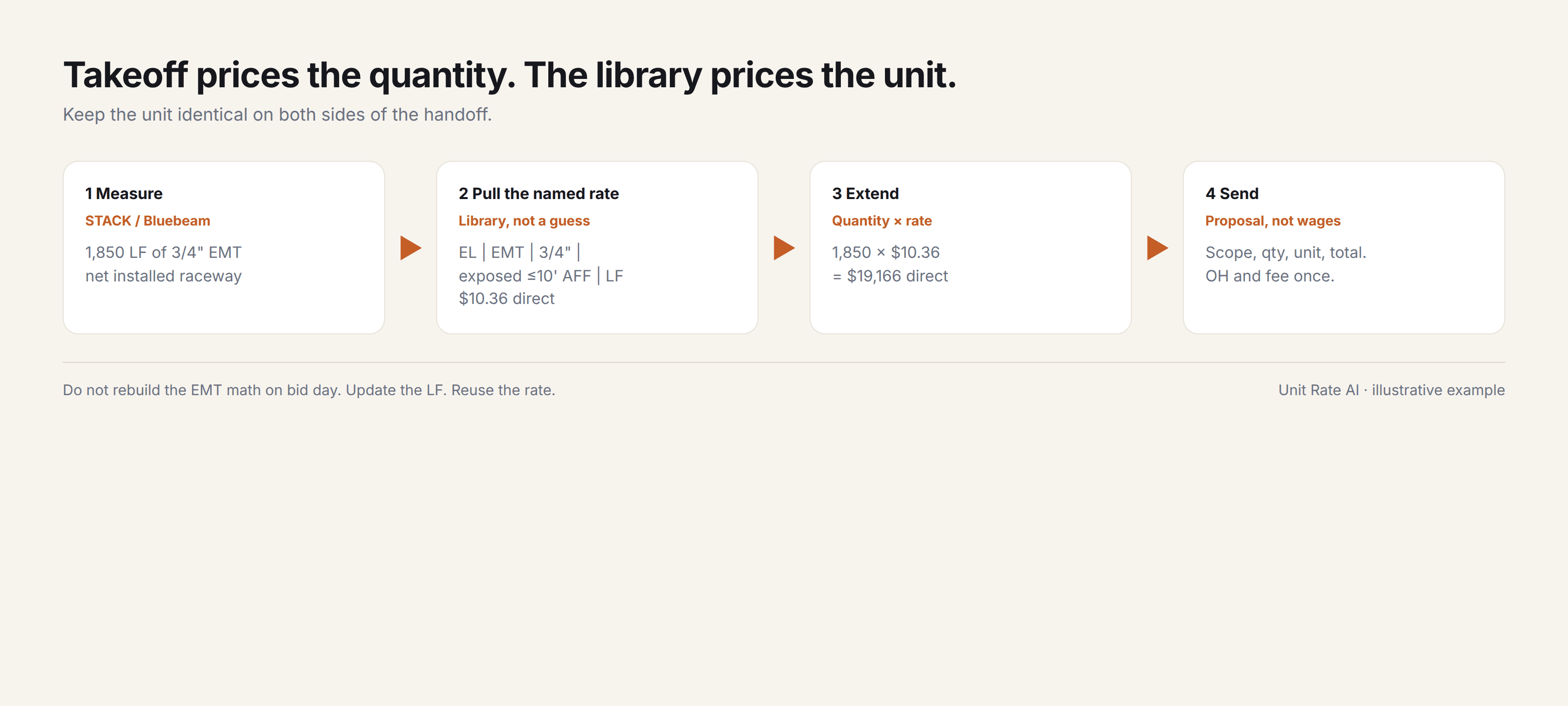
The handoff is mechanical if the library is honest:
- Measure in takeoff software. Keep the unit identical to the rate (LF of raceway, SF of wall face, EA of door).
- Pull the named rate. Set the quantity. Let the extension calculate. Do not retype $10.36 into a new workbook.
- Apply overhead and fee once, the way the shop actually recovers cost.
- Attach scope language, inclusions and exclusions, and payment terms. Send a branded link that can be accepted or declined.
That is the loop unit rate estimating software is built to hold: private library, proposal, change order against the accepted scope, and a record of what the client did. It is not takeoff software, and it is not a replacement for STACK or Bluebeam. When an addendum adds a homerun, you update the LF in the proposal and reuse the rate. You do not rebuild the EMT math, and you do not go back to the drawings inside the rate tool.
Change orders should come off the same family that won the job. If 3/4" EMT was $10.36 direct at bid and you now need after-hours in an occupied suite, do not invent a lump sum. Use the TI rate plus an after-hours condition so the owner can see the unit math — the worked sequence is in how to price a construction change order. Win/loss review should look at the rates, not only the bottom line. You can lose a TI because EMT is high, because overhead is high, or because you included wire pulling and the competitor did not. Those are different problems.
When unit rate estimating pays off most
Unit rates earn their keep where the work repeats and the drawings move.
- Repeat project types — tenant improvement, retail rollout, multifamily common areas — where the same hang, raceway, door, and ACT items show up every month with different quantities.
- Specialty subs bidding the same scope across multiple GCs. The 3/4" EMT rate should not be reinvented for each invite; the footage and the exclusions should.
- Estimators running several active pursuits at once. Reuse is how a three-person desk makes bid days without copying last month's lump.
- Teams that need junior estimators to produce senior-level consistency. The senior's judgment lives in the rate (hours per LF, waste, what is excluded). The junior's job is to pick the right rate and the right quantity.
- Change-order volume. Occupied TIs and rollouts generate quantity moves. A library that already knows the unit is faster than T&M theater.
It pays off less on a one-off industrial process package you have never installed. Build that as a mini-estimate. Save it as a rate only after you have used it twice.
Common mistakes to avoid
- Copying a rate from an old bid without touching labor or material. Last year's 3/4" EMT stick is not this year's. Neither is last year's wage. The extension will look precise and still be wrong.
- Mixing units under one name. LF of raceway and SF of wall cannot share a label. Neither can "EMT" that sometimes means 1/2" in a ceiling and sometimes 3/4" exposed.
- Putting wire, boxes, and conduit in one LF number. When footage changes, you will not know what moved. Keep 26 05 33 raceway on LF; keep boxes and devices on EA; keep conductors on their own rate.
- Double-loading overhead. Direct $10.36/LF plus 12% OH and 8% fee on the proposal is coherent. The same OH and fee already baked into the library rate, then added again, is not. Pick one home for recovery. The FAQ states how the product applies proposal-level markup.
- Treating the library as static. Productivity is the quiet trigger. If the last three TIs hang conduit at 8 LF per hour instead of 10 because every job is cut-up medical office, version the hours. Do not keep bidding a warehouse assumption.
- Using the rate as a takeoff. The $10.36 does not count the drawings. Bad LF from a missed homerun is still a bad total.
Software will not replace field knowledge. It can keep the structure from collapsing when the person who "just knows the rates" is on a job walk.
Unit Rate AI maintains a private unit-rate library and turns it into client-ready proposals. Keep labor, material, and markup in one place, apply overhead and fee the way your shop recovers cost, and send a branded link. See pricing if you want that loop on the next TI.