
A construction change order is not a second bid. It is a revision to a number the owner already accepted — added footage, a deleted door, a condition that no longer matches the vacant-suite rate that won the job. Commercial shops lose money when the original proposal was a lump and the PM now invents another. The shops that stay whole extend the unit rates that priced the award, apply overhead and fee the same way they did on bid day, and send a line the owner can check against the drawings.
This article is that after-award sequence. The bid-day workflow — scope, takeoff, markup, terms — lives in how to price a commercial construction project. Before award, the same add is a takeoff and estimate revision, not a change order — see takeoff vs estimate vs proposal. The anatomy of a loaded rate lives in how unit rate estimating works. Naming, includes and excludes, and versioning live in how to build a commercial unit rate library. What follows is unit rates → change-order line → overhead and fee.
Start from the bid-day baseline, not a new guess
The contract already picked a price. The change order has to explain how that price moves. That only works if three things stay visible:
- The rate version that won the job. If hang-and-finish was $2.54/SF direct on the proposal, that is the baseline for added or deleted SF unless the change-order language allows a new version.
- The same home for overhead and fee. If bid day applied 12% overhead and 8% fee on the proposal, do that again. Do not bake recovery into the library rate for the change order and leave it off the original — or the reverse.
- A measured quantity in the same unit. Added partitions are SF of wall face. Added raceway is LF of installed conduit. A round-number “add $8,000” is a lump wearing a change-order title.
Sent proposals keep the rate version they used. You do not “fix” an awarded job by editing the master. If gypsum or wages have moved and the clause lets you reprice, say so and point at the new version. Takeoff still happens in the tool you already use to measure drawings. The change-order file prices the delta — the same unit handoff as the original pricing workflow.
Worked example: a conference room on the 4,200 SF suite
The through-line is the same illustrative 4,200 SF office tenant improvement from the other guides — vacant second-floor suite, Class B building, standard shift, GC self-performing interiors, electrical and HVAC bought or quoted. Every dollar that looks like a cost is a 2026 U.S. mid-market example. It is not RSMeans. It is not a real client.
Bid day already priced the package: $137,345 direct, $16,481 overhead (12%), $12,306 fee (8% of direct + overhead), $4,120 contingency, $170,252 accepted. Hang-and-finish 5/8" Type X was $2.54/SF direct. 3/4" exposed EMT was $10.36/LF direct. A 3070 hollow-metal door, frame, and specified hardware was $1,480 each. Those build-ups live in the library and unit-rate guides.
Two weeks after award, the owner sketches a conference room on the east wall and an IDF closet off the corridor. The suite is still vacant. The shift is still standard. The change is quantity, not condition.
Change-order scope (illustrative takeoff, openings deducted where that is the shop rule):
- Hang and finish 5/8" Type X, Level 4, interior walls ≤10' on 20ga studs: 680 SF (both faces of the new conference and IDF partitions).
- 3/4" EMT, exposed, ≤10' AFF: 290 LF (IDF homerun plus conference power and data raceway).
- Door + frame + specified hardware, 3070 HM: 1 EA.
Studs, paint, ACT, devices, and conductors are other lines or by others on this example — the same split the original proposal used. If those trades move, they get their own rates. Do not hide them inside the gypsum number.
Extend the bid-day rates
Pull the named rates. Set the quantities. Let the extension calculate. Do not retype $2.54 into a new workbook and hope it is still the awarded number.
| Line | Qty | Unit | Direct rate | Extension |
|---|---|---|---|---|
| Hang+finish 5/8" Type X, L4, ≤10' | 680 | SF | $2.54 | 680 × $2.54 = $1,727.20 |
| 3/4" EMT, exposed ≤10' AFF | 290 | LF | $10.36 | 290 × $10.36 = $3,004.40 |
| Door+frame+hw, 3070 HM, spec set | 1 | EA | $1,480 | 1 × $1,480 = $1,480.00 |
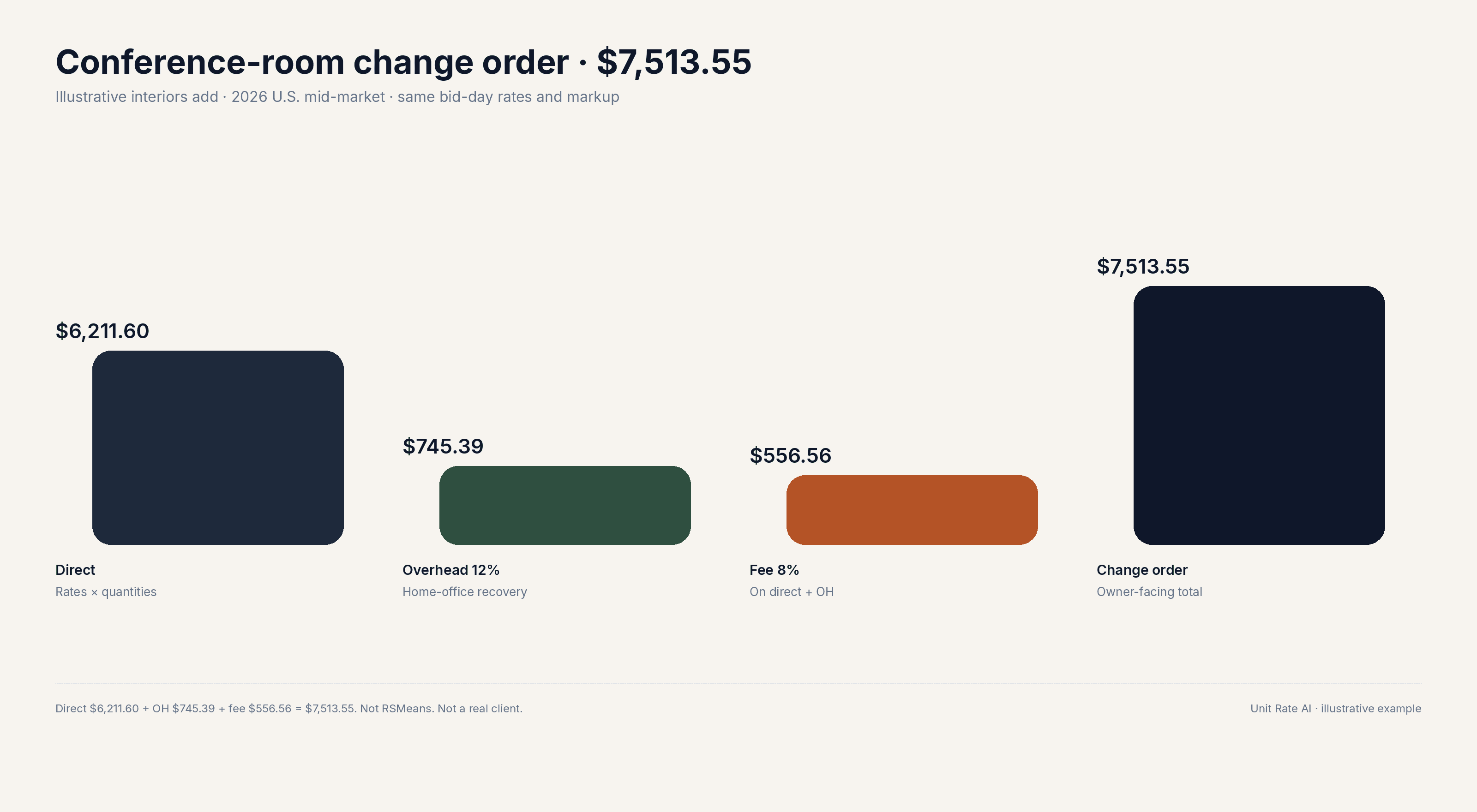
| Direct subtotal | $6,211.60 |
Check the arithmetic before markup: $1,727.20 + $3,004.40 + $1,480.00 = $6,211.60 direct. The 290 LF is the same IDF homerun add as the unit-rate guide (1,850 + 290 = 2,140 LF; 2,140 × $10.36 = $22,170.40 against $19,166.00). Show that raceway line. Do not blend it into an “electrical add.” The published 3/4" EMT, exposed packet is a different number — do not mix it with the $10.36 mid-market table. Electrical shops can start from electrical estimating software.
Apply overhead and fee the same way as bid day
On the awarded proposal, library rates stayed direct. Markup sat on the proposal: 12% overhead on direct, then 8% fee on (direct + overhead). The change order uses that method, matching how overhead and markup work in the product. Why those recoveries differ from contingency is in overhead, fee, and contingency on commercial bids.
- Overhead: 12% of $6,211.60 = $745.39
- Direct + overhead = $6,956.99
- Fee: 8% of $6,956.99 = $556.56
- Change-order total: $7,513.55
That is $6,211.60 + $745.39 + $556.56. It is not 20% of direct typed into a cell. Sequential 12% then 8% is not a 20% add-on: $6,211.60 × 1.20 = $7,453.92, $59.63 light of the bid-day method. Recover cost the same way after award.
The original $4,120 contingency was tagged to unanswered above-ceiling MEP. It does not automatically ride onto this measured add. If the IDF punch still risks undocumented MEP moves, carry a stated allowance — or keep the exclusion. Do not bury risk inside the $2.54 gypsum rate.
When the condition changes, change the rate
Quantity is the easy change order. Condition is the one shops hide inside a lump.
Suppose the same conference room is issued after the suite is occupied, after hours. The vacant Type X rate is the wrong rate. Productivity is slower. The wage may carry a shift premium. Material does not change — the board is still 5/8" Type X. Name an after-hours rate. Do not hide a silent 15% on the vacant number.
The library build-up for vacant hang-and-finish was 0.0279 labor-hours per SF at a $60.72 loaded wage: 0.0279 × $60.72 = $1.69/SF labor, plus $0.85/SF material and tools, for $2.54/SF direct. For this after-hours occupied example, hold material at $0.85 and change only labor:
- Hours: 0.0279 × 1.35 = 0.037665 hr/SF (occupied, night shift, cut-up conference room)
- Loaded wage: $60.72 × 1.10 = $66.79/hr (10% shift premium on the same composite)
- Labor in the rate: 0.037665 × $66.79 = $2.52/SF
- Material + tools: $0.85/SF
- After-hours direct rate: $2.52 + $0.85 = $3.37/SF
On the same 680 SF: 680 × $3.37 = $2,291.60 gypsum direct, against $1,727.20 vacant — a $564.40 condition premium on hang-and-finish. If EMT and the door stay on the vacant bid-day rates, direct becomes $2,291.60 + $3,004.40 + $1,480.00 = $6,776.00.
- Overhead: 12% of $6,776.00 = $813.12
- Direct + overhead = $7,589.12
- Fee: 8% of $7,589.12 = $607.13
- Occupied after-hours total: $8,196.25
That is $682.70 above the vacant $7,513.55 change order. The owner can see which line moved (gypsum) and why (hours and wage). “After-hours premium $2,500 LS” is a number nobody can defend in a draw meeting. The rate library exists so that condition is a named rate.
Credits and deletes use the same family
Owners also take work out. The same rates that added the door should credit the door.
The awarded proposal had eight 3070 hollow-metal doors at $1,480 each ($11,840 direct). The owner deletes two west-wall openings. Credit: 2 × $1,480 = $2,960.00 direct. Apply the same 12% / 8% method so the credit is not thinner than the add:
- Overhead credit: 12% of $2,960.00 = $355.20
- Direct + overhead = $3,315.20
- Fee credit: 8% of $3,315.20 = $265.22
- Credit total: $3,580.42
Check: $2,960.00 × 1.12 = $3,315.20; $3,315.20 × 1.08 = $3,580.42. Crediting direct only leaves the owner paying recovery on work you will not install. If the contract says credits are direct-only, say so. A door already hung is not a clean $1,480 credit — credit the unused buy, keep labor already spent, and add demo or patch as its own lines.
What the owner should see
Unit rates stay internal. The change-order PDF or review link should show scope, quantity, unit, and line total — the same surface as the proposal. Wage, burden, and waste stay in the library unless the contract demands a unit-price schedule. On this add that is 680 SF of Level 4 hang-and-finish at $2.54, 290 LF of 3/4" exposed EMT at $10.36, one specified 3070 door at $1,480, and 12% / 8% applied once. If the suite is now occupied after hours, send the $3.37/SF gypsum rate and the $8,196.25 total instead.
Send a branded link that can be accepted or declined, the same path as the proposal. Do not leave approval in an email thread the PM cannot find when the pay app is due. That is the loop unit rate estimating software is built to hold: private library, awarded proposal, change order against that scope, and a record of what the client did. More guides sit on the resources index. See pricing if you want that loop in one place instead of a second spreadsheet that drifts from the award.
When T&M is still the honest number
Unit rates are the default when the work is measurable and you have installed it before. Time-and-material still belongs when existing conditions are sealed (no as-builts above the ceiling), when the assembly is a one-off — the same rule as the pricing workflow — or when the contract forces T&M. Internally you can still extend units so you know whether the ticket covers cost. The failure mode is T&M because the library was empty, then defending tickets on work that was always hang-and-finish SF.
Common mistakes to avoid
- Inventing a lump because the drawings moved. The 680 SF and 290 LF already have rates.
- A different markup method than bid day. Sequential 12% then 8% produced $7,513.55. A 20% add-on produces $7,453.92.
- Overwriting the master to “update” an awarded job. If stick or wages moved, issue a stated new version. Do not silently edit $2.54 to $2.71.
- Hiding a condition change inside the vacant rate. After-hours gypsum is $3.37/SF here, not $2.54 plus a vibe.
- Crediting direct and keeping overhead on deleted work. Two doors are a $3,580.42 credit under the bid-day method, not a $2,960.00 courtesy.
- Putting wire, boxes, and conduit in one electrical add. Keep raceway on LF; keep devices on EA.
- Using the change order as a takeoff. The $10.36 does not count the drawings.
Software will not replace a PM who walked the room. It can keep the change order on the same book that won the job when that PM is on another floor.
Unit Rate AI maintains a private unit-rate library and turns it into client-ready proposals and change orders. Keep labor, material, and markup in one place, apply overhead and fee the way your shop recovers cost, and send a branded link. See pricing if you want that loop on the next add.